Canada (English)
 Colombia
 Caribbean and Puerto Rico
 Ecuador
 India
 Indonesia
 Ireland
 Malaysia
 Mexico
 Panama
 Peru
 Philippines
 Singapore
 South Africa
 Sri Lanka
 Thailand
 United Kingdom
 United States

What is Enterprise Resource Planning (ERP) For Construction Software?
ERP software for construction industries brings all the features and functions needed to run a construction business into one unified software solution. By definition, an ERP solution combines all the capabilities needed by internal and external stakeholders to run the business under one roof. Construction software supports bids and estimates; building information management (BIM); project planning, scheduling, and risk controls; employee and contractor management; procurement; inventory management; and financials. The ERP system allows for the management of all these enterprise functions in a single enterprise software package.
There are many participants in the construction industry. Architects and engineers develop building plans. These plans are the basis for project bids and estimates. These bids and estimates turn into contracts agreed upon by contractors and subcontractors. The building projects themselves can take months or even years to complete, while every nail and screw purchased impacts the project’s bottom line. The scheduling and staffing of construction projects are subject to the effects of a wide range of factors, some of which (such as the weather, for example) are out of the control of the project participants. After completing a construction project, the asset becomes the responsibility of another party for future maintenance and support services.
The entire construction industry landscape comprises residential and commercial construction firms; general contractors and specialty contractors such as electricians and plumbers; design and engineering firms; property and facilities management companies; and off-site and modular construction companies. Larger companies will often offer products and services from one or more of these segments of the overall industry landscape. Regardless of the products or services offered, a construction company needs enterprise applications to support the unique needs of their business now and into the future.
Historically, the construction industry has been underserved by ERP software providers. The solutions that have been available each support a specific aspect or stage of the construction process. For example, some solutions on the market target architects and engineers and only adequately support these professional services providers. Other solutions address the specialized requirements of contractors and subcontractors, including their complex payroll processing requirements. And some other solutions are better suited to the building managers who take over with the management of tenants and the facility. Completely different solutions often support these different phases of the construction process.
Recent significant technological strides have played out on all ends of the construction software spectrum. The tools for developing BIM models and the adoption of BIM standards enable building plans to support 4 to 6 dimensions. (These additional plan dimensions house schedule information, materials specs, or other supporting information.) In the field, mobile phones, Internet of Things (IoT) devices, drones, and wireless networks make real-time monitoring and updates a reality. These deep vertical software capabilities are now being combined within the backbone of ERP systems to create a solution that can meet the complex needs encompassing the entire lifecycle of a large construction organization.
This guide helps unlock essential considerations to understand when evaluating ERP solutions for construction industries. The guide breaks down the business benefits, functional areas, and market trends of ERP for construction enterprise applications. Finally, the guide provides the necessary info your organization needs to know to select the best-fit software for your construction business and presents the top ERP solutions for construction on the market that may be worth your consideration.
Benefits of ERP For Construction Organizations
Improved Project Controls
Construction projects can quickly spin out of control. Putting up a building requires rigid planning and strict project controls. The simplest scheduling mix-up can cause an entire project to be delayed. These delays lead to headaches at best. In most cases, the delay will lead to additional project costs. For example, poor planning with a single plumbing contractor pushes back the dates for the sheetrock crews to start closing the walls. A construction ERP system supports detailed task and resource tracking to ensure the project stays on track.
Gestion des ressources
People are the most important resources in a construction organization. Equipment and materials are additional resources to manage. Managing the entire organization’s resources in terms of skills, assignments, capacity, and availability go hand in hand with extensive project controls. Quickly assigning additional resources or shifting them between projects can make the difference between meeting a timeline or falling behind and into red ink. Expensive equipment need not sit idle on one job site when needed at another site. An ERP solution provides a full view of all resources that are available to apply to a given project.
Contrôle de documents
ERP systems are built on sophisticated software platforms, which include important business tools. These business platform tools provide capabilities for reporting and analytics, business process automation, and document management. There are many documents needed to execute construction efforts. The list includes, but is not limited to, contracts and agreements to do the work, plans for the work to be performed, and specific documentation for government work. These documents undergo revisions and updates regularly throughout a project. The majority of ERP solutions for construction have fully integrated document management systems built into their software platform.
Amélioration de la collaboration
A central ERP database, in conjunction with collaboration tools, promotes improved collaboration across all departments. Data and processes from each business group flow through the ERP, connecting the effort of separate departments into a streamlined system. Collaboration tools let people follow important tasks. Without an ERP system, the work performed by different workgroups remains separate from one another, requiring more effort to collaborate, prevent information silos, and avoid process inefficiencies.
Employee Satisfaction
Running a construction operation requires trained and dedicated personnel. Engineers, project managers, and skilled and unskilled labor are all vital for the success of the organization. Today’s ERP systems give employees the training and tools needed to perform their job in real time using the latest in mobile technology. ERP for construction software automates many mundane tasks, freeing the employees to do the skilled and meaningful work they signed up to do. Employees are more satisfied when they don’t spend days in an endless cycle of frustrating tools that do nothing to help them perform their jobs.
WHAT TO LOOK FOR IN A CONSTRUCTION ERP SOLUTION
Construction companies require software that supports a complex and dynamic business. This entails a complete set of thousands of business requirements to fully support the needs of construction organizations. An ERP solution for the construction industry is a set of functional modules. Each functional module links to the other functional modules via the electronic ERP backbone. The backbone allows any module to work with any other module when needed. For example, in construction projects, a task in the project plan that calls for a pallet of roofing material would be automatically passed to the purchasing group for order and delivery to the module manufacturing facility. All updates to the task would be shown in real time to all affected parties using the ERP system. Major functional modules in an ERP for construction solution include customer experience applications, bid and contract management, asset and facilities management, back-office applications, modular and off-site manufacturing, and project execution, as shown in figure 1.
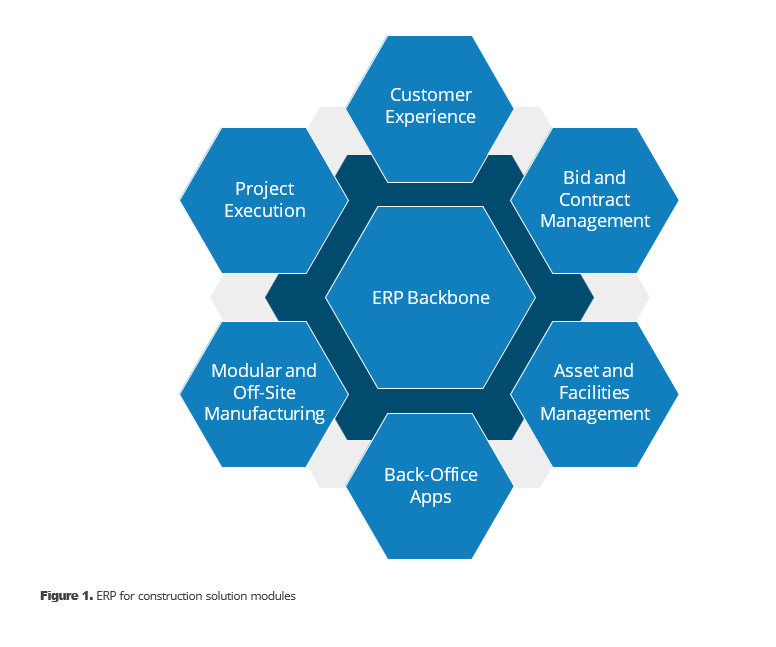
Bid and Contract Management—Developing bids and contracts in construction industries is an extremely important and complicated process. Construction efforts begin with the bid and contracting stages. Architects and engineers first design the asset to be built (a house, an apartment building, or a naval destroyer). That design forms the basis for bids gathered from internal and external contractors. The bids eventually turn into contracts and associated subcontracts. The contracts have many special provisions and special handling, such as retention and holdbacks on payments. The contracts can undergo significant small- and large-scale changes over their lifetime. All the contract complexities in the construction industry require special handling by the ERP system’s built-in bid and contract management system.
Project Management and Execution—The heart of a construction ERP solution is support for the execution of projects. Construction companies manage both large and small projects. The estimated, planned, committed, and actual costs for projects are tracked in real time. All project participants enter time and expenses against the project from any device and any location. Construction projects require the execution of linked purchase orders to acquire new materials, equipment, and staff. Cost and work breakdown structures run side by side against a project providing additional control and visibility. Embedded resource management makes it possible to find the right resources at the right time. Projects tasks and statuses may be automated or require manual intervention depending on project requirements. The successful completion of complex construction projects requires an ERP system that is up to the task.
Customer Experience Applications—Today, every company needs applications that oversee customer interactions. The construction company needs to keep up to date on its best customers and all interactions with those customers. Construction companies need to handle any service calls or complaints that come in from these customers. Many construction companies also offer other products, warranties, or management services to their customers. Customer relationship management (CRM) and customer service tools provide the needed customer-facing applications to ensure a satisfying customer experience throughout the project’s lifecycle.
Back-Office Applications—The back office of an ERP solution houses all the sometimes dull but still critical applications to run the business—human capital management (HCM), financials, payroll, and inventory management. HCM systems manage the personnel-related tasks for corporate managers and individual employees, including personnel management, benefits management, payroll management, employee self-service, and health and safety. The financials system contains the corporate general ledger, along with managing the company’s receivables and payables. A construction ERP system deserving respect can manage the burdensome payroll processing requirements that govern the industry. The valuable building materials used in construction efforts are managed by the ERP system’s inventory management application.
Modular and Off-Site Manufacturing—The industry is increasingly leveraging modular and off-site construction. This type of construction helps bring down costs and produce repeatable results in a more controlled environment. The manufacturing capabilities of ERP systems are ideally suited to supporting requirements in the construction for modular and off-site manufacturing. Increased housing costs are forcing construction companies to come up with creative ways to cut the cost of building, with modular and off-site manufacturing offering some help. Even companies that offer cookie-cutter housing units benefit from the application of mass production manufacturing techniques.
Asset and Facilities—Large assets and facilities add another wrinkle in running construction businesses. Cranes, trucks, and trailers are valuable assets. These assets should not be left idle and require regular maintenance and repairs. Some construction companies maintain the asset or facility after construction. Asset and facilities management software, known as enterprise asset management (EAM) software, manages the lifecycle of large and complex assets. EAM software houses the structures and supporting business processing tools to manage assets such as manufacturing production equipment, offshore oil rigs, highways, facilities, municipal transportation systems, and fleets of vehicles.
ERP Backbone—ERP systems are built on top of software backbones. The backbone (or platform) is the underlying foundation and plumbing of the ERP system. Modern ERP application platforms run on cloud infrastructure services such as Microsoft Azure, Amazon Web Services, or Oracle’s platform services. Other services provided by the underlying software platforms include:
- Business intelligence (BI)
- Gestion documentaire
- Internet of Things (IoT) processing
- E-signature
- Open application programming interfaces (APIs)
Trends Shaping the Future of Construction ERP
Players Across the Industry Are More Broadly Adopting Modular and Off-Site Construction—The trend has gained steam in Europe, with interesting new players such as home-furnishing giant Ikea entering the marketplace. Modular construction enables construction to take place in controlled environments away from the effects of different weather conditions. The schedules of all tradespeople (electricians, drywall installers, plumbers, framers, etc.) are easier to manage and control. Repeatable processes lead to more reproducible results. The net result is consistently better quality and lower costs. This trend will continue as countries look for ways to build more affordable housing.
Building Information Modeling (BIM) Software—BIM products move construction designs and drawings beyond 3D. The BIM tools serve as the foundation for digital transformation in the construction industry. The additional dimensions hold costs, schedules, materials, and additional properties of the material. Housing this additional information in the model adds the critical missing link to the better management of construction projects. This digital twin models an asset throughout its lifetime from design to build and through to ongoing maintenance. The ERP solutions serving the industry have seamless bidirectional integrations with BIM products.
Mobile and 5G Wireless—The availability and costs of smartphones (and other mobile devices) are critical to construction companies. The expanding global 5G network infrastructure brings additional bandwidth and precision to mobile work. 5G networks can pinpoint a device’s location within a few centimeters, with transmission rates rivaling wireless networks. The spread of 5G networks enables construction workers to share a real-time video of site conditions and free workers for more meaningful work. Mobile device capabilities, combined with the increased global 5G coverage, opens the door to new opportunities across the entire construction industry.
3D (Additive) Printing—3D printing is seeing more mainstream adoption in the construction industry. Projects are currently being completed and planned where a 3D printer prints the structure of the house, for example. Additional applications abound in the construction industry. With a 3D printer, an electrician could print the custom conduit and junction boxes needed for a job. A job site could have a printer dedicated to printing standard and custom parts needed for a project, thus eliminating the many steps involved in purchasing, acquiring, and transporting a part to a job site. Using 3D printers also frees a company from managing parts inventory or enables a company to create a replacement for a minor broken piece of equipment. The construction industry’s adoption of this technology can replace and eliminate a range of project bottlenecks.
Artificial Intelligence (AI)—AI is all about making machines smarter and undertaking more intelligent tasks. AI technologies form the basis of tools such as converting a sentence from a worker in the field into text and translating it so that an engineer in say Düsseldorf, Germany, can work diagnose the problem over a chat. AI technologies are being applied across ERP solutions. AI software and hardware range from chatbots, digital assistants, image recognition, natural language processing (NLP), robotics, and machine learning (ML) tools. AI applications are freeing the hands of workers at the job site for more productive work. Other AI tools constantly learn from project data to build better buildings and apply learnings to other projects. Because of their enormous potential, AI applications rolling out today will impact all areas of ERP and other construction solutions.
ERP FOR CONSTRUCTION SOFTWARE SELECTION
Construction ERP solutions are gaining popularity in the broader ERP marketplace. In the past, some ERP vendors shied away from delivering solutions for the construction industry. This aversion to the industry was due to several factors. Such major hurdles included the paucity of software and devices that were available to the average construction worker in the field to do their job. Mobile devices and the latest generation of software have removed that hurdle. Other problems relate to the subtle complexities in the marketplace that the major ERP vendors do not wholly understand or know how to address. For example, the contracting cycle and payroll management requirements in the construction industry are very different from those in other industries.
TEC comprehends the difficulties in choosing an ERP solution for the construction industry. The overall process of selecting an ERP solution can be complicated and arduous. The decision to buy an enterprise-grade solution is a long-term investment that a company lives with for many years to come. TEC’s experts use a time-tested, data-driven, and structured approach to software selection. This approach begins with understanding your current business operations and application landscape. The process then identifies the top vendors that can meet those needs and narrows it down to a shortlist for the final phase of the selection. TEC can deliver results in weeks, where other selection providers take months.
TEC’s resources can help with the entire software evaluation and selection process or assist in different phases in an à la carte fashion. TEC’s experts have decades of experience solving problems for companies across the globe. The broad list of free resources includes RFP templates, software modules, and features lists, and comparison charts. Our experts use TEC’s proprietary tool, TEC Advisor, to enable your organization to select the best construction ERP solution for your business needs.
Top Construction ERP Software Vendors
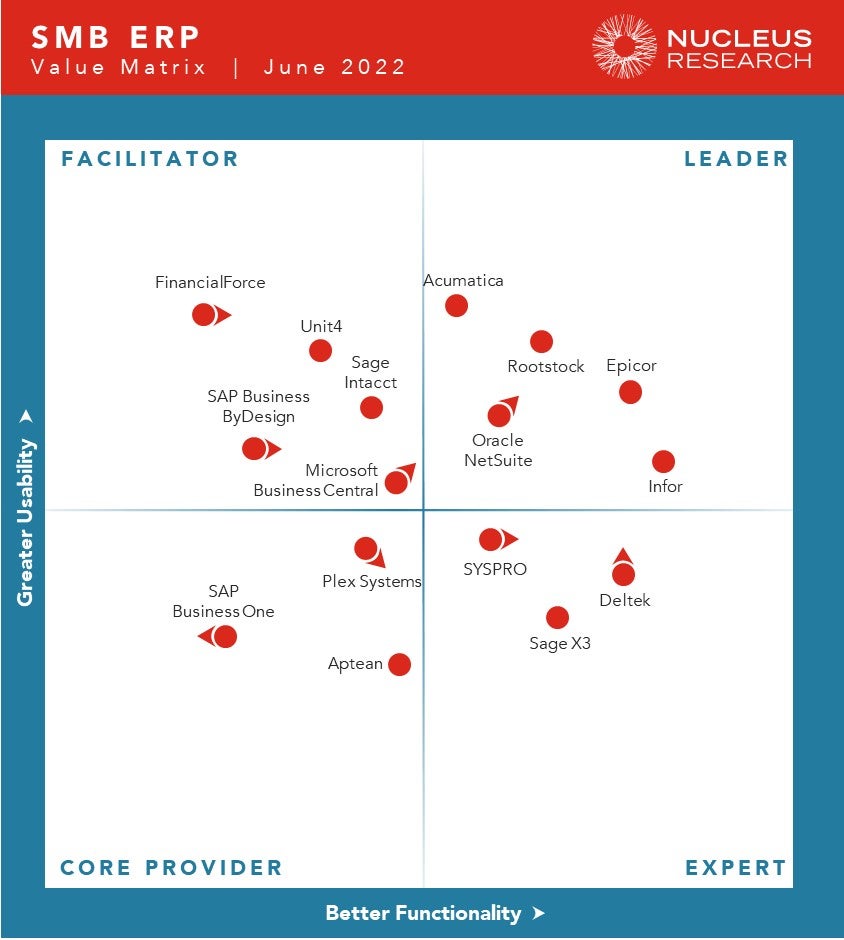
Many vendors provide solutions for construction organizations. Some solutions may target companies in a specific region or country. Other ERP solutions are designed and built for a particular service vertical such as general contractors, modular builders, or architecture and engineering businesses. Here is a list of leading providers of construction ERP software:
- Acumatica
- Adeaca Corp
- BuilderTrend
- CMiC
- Épicurien
- IFS
- Microsoft
- Oracle
- Oracle NetSuite
- Penta Technologies
- Procore
- Sage (Sage X3)
- SAP
Conclusion
Great progress is being made by construction ERP software solutions in recent years. Advances in underlying technologies such as cloud computing, mobile devices, and mobile networks have made these solutions more accessible to organizations across all verticals of the construction industry. ERP providers have spent years honing ERP software for the complicated and fluid nature of the construction business. It is important for construction industries to look at the extremely powerful and sophisticated ERP tools on the market today to help them optimally run all aspects of their business. For those organizations needing additional info or help with evaluating or selecting an ERP solution for their organization, check out our services or contact TEC today.