Canada (English)
 Colombia
 Caribbean and Puerto Rico
 Ecuador
 India
 Indonesia
 Ireland
 Malaysia
 Mexico
 Panama
 Peru
 Philippines
 Singapore
 South Africa
 Sri Lanka
 Thailand
 United Kingdom
 United States

AN A L Y S T
Charles A. Brennan
En fin de compte
Nucleus found that the small to medium-sized business (SMB) ERP market is increasingly defined by the need to balance operational sophistication with simplicity. As organizations face growing operational complexity, labor constraints, rising costs, and increasing customer expectations, ERP platforms are being evaluated not only for their ability to manage financial transactions but also to automate processes, improve visibility, and support growth without requiring proportional increases in headcount or administrative overhead. While AI, automation, and embedded intelligence have become major areas of vendor innovation, SMB customers remain focused on practical use cases that deliver measurable business outcomes through labor
efficiency, process acceleration, and improved decision-making. As a result, the market continues to evolve toward more connected, industry-aware, and operationally focused platforms. The vendors best positioned for long-term success will be those that can combine usability, automation, industry expertise, and operational visibility to help organizations scale efficiently while delivering measurable returns on technology investments.
Market Overview
Nucleus found that the SMB ERP market is evolving rapidly as small and midsize organizations modernize operations to support growth, improve visibility, and reduce reliance on manual processes. While many SMB organizations historically adopted ERP primarily for financial management and transactional control, the market is increasingly shifting toward operational coordination, automation, and real-time decision support. SMBs are facing many of the same pressures impacting large enterprises, including supply chain volatility, labor shortages, rising operating costs, and customer expectations for faster service and greater transparency. However, they often face these challenges with leaner teams, smaller IT departments, and fewer internal resources. As a result, many SMB organizations are increasingly evaluating technology investments based on their ability to improve productivity, automate manual processes, and support growth without proportional increases in headcount, placing greater importance on usability, deployment speed, and operational efficiency.
Analysts observed that SMB organizations are increasingly turning to ERP platforms not only to manage accounting and reporting, but also to serve as a centralized operating environment that connects finance, inventory, procurement, manufacturing, project management, customer operations, and supply chain activities. As SMBs scale, many are becoming operationally complex earlier in their lifecycle than previous generations of businesses. These organizations seek technologies that allow them to scale revenue, operations, and organizational complexity without proportionally increasing administrative or operational staffing levels. Venture-backed companies, rapidly expanding distributors, modern manufacturers, ecommerce organizations, and multi-location businesses increasingly require capabilities such as multi-entity consolidation, intercompany accounting, regional compliance, inventory visibility, and global financial reporting at earlier stages of growth. This is changing expectations for SMB ERP vendors and driving greater investment in functionality previously associated primarily with enterprise ERP systems.
At the same time, SMB customers continue to prioritize simplicity and ease of use. Many SMB organizations are family-owned businesses or founder-led companies undergoing generational transition, and newer leadership teams increasingly expect business software to resemble the modern consumer applications they use outside of work. This has accelerated demand for cleaner user interfaces, conversational workflows, embedded analytics, mobile accessibility, and more intuitive user experiences. While enterprise organizations also value usability improvements, the impact is often more pronounced in SMB environments where organizations may lack dedicated technical teams or formal training resources. SMB customers are therefore placing greater emphasis on solutions that reduce complexity while still supporting operational growth.

AI has become one of the fastest-moving areas of innovation in the SMB ERP market, particularly around finance automation, reporting, and workflow assistance. Nucleus found that nearly every leading SMB ERP vendor introduced some form of copilot, AI assistant, AI agent, or AI workflow framework over the last 12 to 24 months. Vendors are positioning these tools to automate repetitive tasks, improve reporting, accelerate analysis, and reduce manual accounting work. Common use cases include accounts payable processing, reconciliations, financial close assistance, invoice matching, report generation, variance analysis, summarization, SEO, and product description generation, and natural language reporting.
However, Nucleus found that SMB adoption of AI remains practical and measured rather than transformational. Most SMB organizations are not looking to deploy large-scale autonomous systems. Instead, they are focused on supportive tools that help lean teams operate more efficiently. Customers are generally most interested in AI capabilities that reduce repetitive work, simplify reporting, summarize information, identify anomalies, or improve responsiveness in customer service and operational workflows. For many organizations, the primary objective is not autonomy, but rather enabling lean teams to accomplish more work with existing resources. Embedded AI capabilities integrated directly into finance, inventory, procurement, or operational workflows are receiving stronger interest than standalone AI products or highly experimental use cases.
Nucleus observed that many SMB organizations are already experimenting with commercial AI tools such as ChatGPT, Claude, or
Gemini to support reporting, analysis, documentation, and workflow automation outside the ERP system. As a result, SMB ERP vendors are increasingly positioning themselves as governed operational systems that can connect AI to trusted financial and operational data. Vendors are embedding AI directly into workflows while also expanding support for external AI connectivity, orchestration frameworks, and natural language interfaces. The market is beginning to move away from isolated AI assistants toward workflow-aware systems that can participate in day-to-day operational execution.
Despite this acceleration, Nucleus found that maturity levels across the SMB market remain highly inconsistent. Many SMB organizations still rely heavily on spreadsheets, disconnected applications, manual reporting, and tribal operational knowledge. Data governance, process standardization, and reporting maturity vary significantly across companies by size, industry, ownership structure, and growth stage. In many cases, SMB organizations are attempting to modernize operations while simultaneously formalizing business processes for the first time. This creates both opportunity and risk. ERP vendors can deliver meaningful operational improvements, but organizations still need sufficient process discipline, change management, and internal ownership to operationalize automation and AI capabilities effectively.
Industry specialization continues to grow in importance throughout the SMB ERP market. Nucleus found that customers increasingly want vendors that understand their specific operating environment and can support industry-specific workflows out of the box. Manufacturing organizations are prioritizing stronger connectivity between ERP, manufacturing execution, quality management, warehouse operations, and supply chain processes. Construction and project-based businesses are seeking better visibility into job costing, labor tracking, subcontractor management, and field operations. Distribution and retail organizations continue to prioritize inventory visibility, fulfillment efficiency, supplier coordination, and e-commerce integration. This demand has driven SMB ERP vendors to deepen vertical capabilities and expand ecosystem integrations across operational domains.
Integration flexibility is also becoming increasingly important. While SMB customers continue to prefer simplified technology environments with fewer disconnected systems, they still expect ERP platforms to integrate with e-commerce applications, payment platforms, banks, payroll providers, tax systems, robotics solutions, analytics tools, manufacturing technologies, and external AI services. Nucleus found that the SMB market is increasingly favoring vendors that can balance platform simplicity with extensibility. Customers want solutions that are configurable enough to support business growth, but not so complex that they require large implementation teams or extensive ongoing maintenance.
Another major trend in the SMB ERP market is the growing importance of embedded financial ecosystems. Vendors are increasingly integrating payments, treasury management, payroll, expense management, tax automation, banking connectivity, and fintech services directly into ERP workflows. This is particularly attractive for SMB organizations because it reduces IT burden, shortens deployment timelines, simplifies vendor management, and creates more unified operational workflows. Nucleus found that many SMB customers are prioritizing platforms that can centralize operational and financial activities while minimizing the number of disconnected applications employees must manage daily.
Cloud ERP adoption also continues to accelerate across the SMB market. Historically, cloud adoption in SMB environments was often driven by infrastructure simplification and lower upfront costs. Analysts found that the conversation is now increasingly tied to operational agility, remote accessibility, embedded automation, and access to ongoing innovation, particularly around AI and analytics. Vendors are concentrating product innovation in cloud environments, making modernization decisions increasingly strategic for SMB organizations seeking to remain competitive and scalable.
Usability, services, and customer support remain major differentiators in the SMB ERP market. SMB organizations often operate with smaller internal support teams and rely heavily on vendors and implementation partners for onboarding, enablement, and issue resolution. Nucleus found that customers continue to place strong emphasis on implementation speed, support responsiveness, practical training resources, and vendor accessibility. Poor support experiences, slow ticket response times, or overly complex deployment processes can significantly impact usability and customer satisfaction, particularly for smaller organizations without dedicated ERP administrators.
Looking ahead, analysts expect the SMB ERP market to continue evolving toward operationally intelligent platforms designed to help organizations improve productivity, increase visibility, and scale operations more efficiently. As economic uncertainty, labor constraints, and growth pressures persist, SMB customers are increasingly evaluating ERP investments based on their ability to deliver measurable returns through labor efficiency, process automation, faster decision making, and support for growth without proportional increases in headcount. The leading vendors will likely be those that can combine usability, embedded automation, industry specialization, and practical AI capabilities into cohesive workflows that reduce manual effort and improve operational coordination without significantly increasing complexity. While AI will remain an important area of innovation, SMB customers are expected to continue prioritizing measurable business outcomes over experimental functionality. Vendors that can help organizations automate repetitive work, improve financial and operational visibility, and accelerate time-to-value will be best positioned to succeed in the next phase of the SMB ERP market.
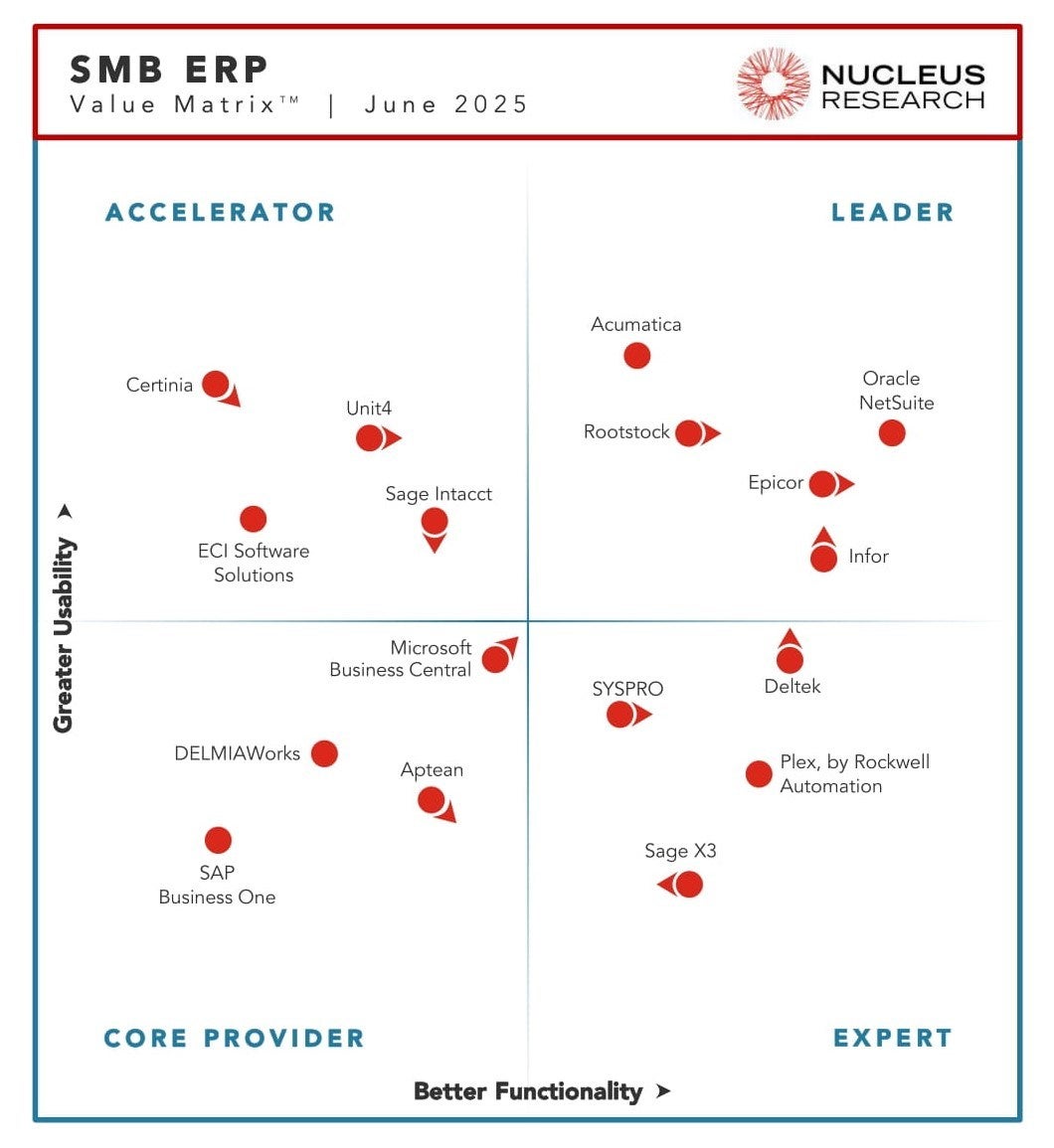
The Nucleus Research SMB ERP Technology Value Matrix provides an assessment of the market based on how vendors deliver value to customers through the usability and functionality of their solutions (Nucleus Research x222 – Understanding the Value Matrix, December 2023). The research is intended to deliver a relevant snapshot of the Marketing Automation technology market, rather than serve as an empirical ranking of the vendors. The arrows indicate each vendor’s perceived momentum and are informed through conversations with end users, recently released capabilities, features, and other areas of investment.
Leaders
Leaders in the SMB ERP Value Matrix include Acumatica, Epicor, Infor, Oracle NetSuite, Rootstock, and Syspro.
Acumatica
Acumatica is recognized as a Leader in the 2026 SMB ERP Technology Value Matrix. Acumatica delivers a cloud-native ERP platform designed for midsized organizations, offering a General Business Edition and industry-specific editions for manufacturing, distribution, construction, retail/e-commerce, and professional services. Within manufacturing, the platform commonly supports organizations across industrial equipment, fabricated metals, electronics, food and beverage, furniture, and
automotive-related operations. In wholesale distribution environments, Acumatica is widely deployed across industrial supply, HVAC, building materials, grocery, auto parts, and e-commerce operations. Its construction capabilities are purpose-built for general contractors, specialty and subcontractors, and heavy civil firms. In contrast, its professional services capabilities are tailored to project-centric organizations such as architects and engineers. The platform provides integrated functionality spanning financial management, customer relationship management, inventory and warehouse management, project accounting, commerce, field service, manufacturing operations, construction project management, and analytics within a unified cloud
environment. Acumatica supports both public and private cloud deployment models, allowing organizations to align infrastructure requirements with operational, security, and compliance needs.
Acumatica continues to differentiate through its consumption-based licensing model, which allows unlimited users and scales based on transaction and resource consumption rather than employee and user count. The platform is built on a single codebase architecture across its industry editions, enabling organizations to standardize workflows while maintaining industry-specific functionality and extensibility. The vendor also continues to emphasize platform openness through the Acumatica Cloud ERP xRP platform, which supports connected applications, embedded industry solutions, workflow customization, low-code development, and third-party integrations across the broader ERP ecosystem.
Recent updates and announcements include:
AI Studio and Configurable AI Automation Enhancements
Acumatica expanded AI Studio capabilities with configurable AIpowered workflow automation, AI assistants, and low-code AI configuration tools designed for business users and partners. These updates allow organizations to automate repetitive operational workflows, apply AI-driven assistance within ERP processes, and configure AI-enabled automation with minimal technical development effort.
Modernized User Experience and No-Code Personalization
Acumatica introduced a modernized browser-based user experience across the platform, featuring configurable layouts, screen personalization, improved navigation, and more consistent workflow experiences. These updates are designed to improve usability, reduce workflow friction, and simplify ERP adoption across operational and back-office teams.
AI-Powered Reporting, Insights, and Operational Monitoring
Acumatica expanded embedded analytics and operational intelligence capabilities through AI-powered anomaly detection, improved reporting, and proactive operational insights across financial, manufacturing, and project workflows. These updates help organizations identify operational issues, monitor changing business conditions, and improve decision-making using ERP operational data.
Industry-Specific Enhancements
Acumatica introduced expanded functionality across Manufacturing, Distribution, Construction, Retail, Professional Services, and Field Service editions, including enhanced production tracking, warehouse orchestration, inventory visibility, project financial management, and operational coordination tools. These updates strengthen Acumatica’s industry-specific operational capabilities while improving execution visibility across manufacturing, distribution, project, and field service environments.
Operational Workflow and Fulfillment Automation Enhancements
Acumatica expanded operational workflow automation capabilities supporting warehouse fulfillment, shipping, procurement, vendor payments, marketplace integrations, and project management processes. These updates are designed to reduce manual administrative effort, improve operational coordination, and strengthen visibility across multi-site and multi-channel operations.
Shop Floor and Real-Time Manufacturing Execution Enhancements
Acumatica introduced new manufacturing execution and shop-floor functionality, including Shop Floor Kiosk capabilities, real-time production tracking, improved labor and cost precision, and expanded inventory visibility for MRP and DRP processes. These updates improve manufacturing execution visibility and support more accurate production, inventory, and operational planning activities.
Épicurien
Epicor is recognized as a Leader in the 2026 SMB ERP Technology Value Matrix. The vendor’s ERP portfolio primarily serves midmarket and enterprise organizations across manufacturing, distribution, automotive, retail, and building supply industries. Epicor provides functionality spanning financial management, supply chain operations, planning, customer relationship management, project management, analytics, and business intelligence, while continuing to emphasize industry-specific workflows and operational flexibility. Epicor’s primary ERP offerings include Epicor Kinetic, which is aligned with discrete manufacturing and make-to-order environments; Prophet 21, focused on distribution organizations; and BisTrack, designed for building supply and lumber businesses. The vendor also continues to emphasize configurability through low-code/no-code capabilities, prebuilt API connectors, and composable add-on modules, enabling organizations to align deployments more closely with operational and industry-specific requirements.
Epicor expanded its focus on AI, analytics, and cloud modernization by introducing Epicor Prism and additional enhancements to the Epicor Grow Data Platform. Epicor Prism introduces a network of industry-focused AI agents designed to support conversational workflows, automation, and operational decision support across supply chain and ERP processes. Epicor Grow provides a centralized data environment that combines data lake and warehouse capabilities to support analytics, reporting, and operational visibility across ERP environments. The vendor also introduced Ascend with Epicor, a migration program designed to support organizations transitioning from on-premises or third-party ERP environments to Epicor’s cloud platform.
Recent updates and announcements include:
Epicor Lux and Prism Agent Foundry
At Insights 2026, Epicor introduced Epicor Lux and Prism Agent Foundry, expanding governance, orchestration, and self-service AI agent development capabilities across the Epicor platform. These updates provide customers and partners with tools to build, customize, monitor, and govern vertical AI agents while maintaining ERP-level security, workflow controls, and operational oversight.
Headless ERP and AI Interoperability Enhancements
Epicor expanded API-first and headless ERP capabilities supporting AI-driven interfaces, agentic workflows, and interoperability with external large language model platforms through emerging standards such as Model Context Protocol (MCP). These updates are designed to allow AI agents to securely execute operational workflows directly within ERP-managed business processes while
preserving enterprise governance and security controls.
Epicor Prism and Vertical AI Expansion
Epicor expanded Epicor Prism, a portfolio of industry-focused AI agents designed for manufacturing, distribution, logistics, and supply chain workflows across Epicor Kinetic and Prophet 21. The platform includes capabilities supporting inventory optimization, shipment tracking, freight analysis, MRP interpretation, EDI monitoring, AP document capture, business rule automation, and workflow execution directly within ERP processes.
Cloud-First ERP Strategy and Platform Consolidation
Epicor continued advancing its cloud-first ERP strategy through the expansion of the Ascend with Epicor initiative, integrating ERP, analytics, AI, and cloud applications into a unified platform environment. The vendor also announced future limitations on major on-premises feature releases for several core ERP products, reinforcing long-term investment in cloud-based deployments and continuous delivery models.
Cloud Management and Self-Service Enhancements
Epicor expanded cloud management, analytics, and self-service administration capabilities across its ERP portfolio, including enhancements to the Epicor Grow Data Platform and Cloud Management Portal. These updates are designed to reduce IT dependency while improving operational visibility, environment management, and user access to embedded analytics and
reporting tools.
Kinetic and Prophet 21 Platform Enhancements
Epicor introduced major updates across Kinetic and Prophet 21, including expanded AI integrations, workflow automation, extensibility improvements, ESG-related functionality, and enhanced logistics and compliance capabilities. The updates also include expanded business rule configuration, mass update tools, shipment tracking visibility, and support for broader operational workflow automation.
Connected Supply Chain and Compliance Integrations
Epicor expanded integration capabilities across supply chain collaboration and compliance workflows through partnerships and integrations supporting supplier collaboration, tax automation, logistics workflows, and connected operational processes. These updates strengthen visibility and coordination across procurement, fulfillment, and financial operations.
Expanded Vertical and Operational Capabilities Through Acquisitions
Epicor continued expanding industry-specific functionality through acquisitions, supporting demand planning, inventory optimization, connected worker operations, product information management, and digital commerce capabilities. These additions expand Epicor’s ability to provide more integrated operational and supply chain functionality within its ERP ecosystem rather than relying on standalone third-party applications.
Governance Enhancements
Epicor continued expanding governance and security controls across Prism AI workflows and cloud environments. The updates include role-based access controls, audit logging, approval-chain governance, and human-in-the-loop operational oversight designed to support secure AI-assisted execution across manufacturing, distribution, logistics, and financial workflows.
Infor
Infor is recognized as a Leader in the 2026 SMB ERP Technology Value Matrix for its portfolio of industry-focused ERP offerings. Infor serves organizations across industries, including industrial manufacturing, automotive, aerospace and defense, distribution, fashion, food and beverage, healthcare, and the public sector. Infor’s CloudSuite portfolio consists of industry-specific ERP suites that combine core ERP functionality with supply chain, warehouse, asset management, human resources, customer relationship management, and product lifecycle management capabilities tailored to targeted vertical markets. These offerings are built on the Infor Industry Cloud Platform and backed by Amazon Web Services (AWS)’ global infrastructure. Infor’s SMB positioning is primarily focused on upper midmarket and lower-enterprise organizations seeking industry-specific ERP capabilities without the complexity of highly customized deployments, particularly in manufacturing, distribution, food and beverage, healthcare, and
asset-intensive industries.
Infor continues to emphasize preconfigured industry workflows and operational processes designed to reduce customization requirements and align deployments more closely with industry-specific business requirements.
Recently, Infor expanded its focus on role-based AI agents, workflow automation, process intelligence, and generative AI through the Infor Velocity Suite. The offering combines process mining, robotic process automation, AI agents, generative AI, and predefined industry use cases designed to help organizations with AI adoption to identify operational inefficiencies, automate repetitive tasks, and optimize operational visibility across manufacturing, distribution, and service-oriented workflows.
Recent updates and announcements include:
Expanded Infor Velocity Suite with AI Use Case Packs and AI agents
Infor expanded Infor Velocity Suite with industry-specific AI use case recommendation packs organized by role, process, and industry. Each pack gives users a clear starting point for adoption to show what areas organizations can immediately benefit from, such as supplier management, financial efficiency, fulfillment efficiency, and more. New Industry AI Agents, enhanced supervisor-led orchestration, and Agent Factory have also been introduced to help organizations accelerate AI agent adoption, orchestration, and extensibility.
Enhancements to Infor Agentic Orchestrator
Infor enhanced the Infor Agentic Orchestrator with expanded coordination capabilities across AI agents, enterprise systems, and external data environments. The updates include interoperability through Model Context Protocol (MCP) integrations alongside expanded monitoring, governance, auditability, and observability capabilities designed to improve transparency and human oversight across AI-driven workflows.
Enhancements to Infor Process Mining with AI
Infor expanded process mining capabilities with generative AIdriven process summarization, enhanced dashboard customization, and deeper process performance analysis tools. These updates are designed to improve operational visibility and help organizations identify inefficiencies across enterprise workflows without relying on a heavily manual process analysis.
AI-driven Warehouse Optimization Enhancements
Infor introduced a Velocity Suite add-on for Infor WMS focused on warehouse pick path optimization using machine learning. The capability is designed to improve warehouse efficiency by reducing travel distance and improving picking workflows within distribution and fulfillment operations.
Expanded AI Deployment and Managed Services Support
Infor expanded post-deployment support capabilities with a year of complimentary CareFor Managed Services tied to Velocity Suite implementations. The offering is designed to provide post-go-live operational guidance and ongoing optimization support as organizations deploy AI-driven workflows and automation initiatives across enterprise operations.
Infor Leap Cloud Migration Offering
Infor introduced Infor Leap, a structured cloud migration offering designed to accelerate ERP modernization initiatives for organizations moving from on-premises environments to Infor CloudSuite applications. The offering emphasizes predefined implementation methodologies, fixed-fee deployment structures, and reduced migration complexity to help organizations improve time-to-value and lower implementation risk.
Oracle NetSuite
Oracle NetSuite is recognized as a Leader in the 2026 SMB ERP Technology Value Matrix. NetSuite provides a unified cloud ERP platform designed for small and midsized organizations, while also supporting select upper midmarket and enterprise environments requiring global financial and operational visibility. Built on a centralized data model, the platform enables real-time visibility and data consistency across financial, operational, supply chain, and customer-facing business processes. NetSuite supports a broad range of functionality, including accounting, billing and revenue recognition, budgeting and planning, professional services automation (PSA), supply chain management, manufacturing execution, warehouse management, human capital management, customer relationship management, field service management, commerce, quality management, and business intelligence within a unified cloud environment.
NetSuite continues to differentiate through its breadth of native functionality, global operational support, and extensibility across industry-specific use cases. The platform supports organizations across the software, financial services, nonprofit, retail, wholesale distribution, hospitality, construction, and manufacturing industries, and provides multi-entity, multi-currency, and global tax management capabilities that support operations across more than 220 countries and territories. NetSuite’s ecosystem is further extended through its Built for NetSuite partner network, which provides pre-integrated applications and workflow extensions aligned to specific operational requirements. Oracle NetSuite recently introduced NetSuite Next, focused on expanding embedded AI and workflow automation and delivering conversational ERP experiences via Ask Oracle across the application suite. In addition, NetSuite has expanded its platform strategy, with capabilities such as the NetSuite AI Connector Service, which enables users to connect with their AI of choice via MCP, and NetSuite Prompt Studio, which enhances customers’ ability to deliver tailored experiences and customized workflows across their entire business processes.
Recent updates and announcements include:
NetSuite Next and Embedded AI Expansion
NetSuite introduced NetSuite Next at SuiteWorld 2025, expanding embedded AI capabilities across ERP workflows through conversational intelligence, natural language search, and agentic workflow automation. Central to the release is Ask Oracle, an AI assistant designed to help users search, analyze, navigate, and act on ERP data using natural language interactions across the NetSuite platform.
SuiteAgent Framework and AI Development Enhancements
NetSuite expanded developer and administrator AI tooling through SuiteAgent frameworks, AI Toolkits, AI Studio, and the SuiteCloud Developer Assistant. These updates enable customers and partners to build, deploy, monitor, and govern AI-driven workflows and ERP extensions directly within the SuiteCloud platform, while reducing development complexity through lower-code tooling and natural language workflow generation.
AI Connectivity and Integration Platform Enhancements
NetSuite expanded integration and interoperability capabilities through the NetSuite AI Connector Service, the NetSuite Analytics Warehouse AI Connector Service, and broader integration platform enhancements that support MCP connectivity with external AI platforms and enterprise applications. These updates strengthen how organizations connect ERP data, workflows, analytics, and AI services across NetSuite and third-party environments.
Financial Automation and Intelligent Close Enhancements
NetSuite introduced expanded finance automation capabilities, including Intelligent Close Manager, payment risk detection, AI-assisted bank transaction matching, and BILL-powered payment automation. These updates are designed to improve reconciliation accuracy, reduce manual financial processing effort, accelerate close processes, and strengthen fraud detection and payment controls.
Subscription Management and Revenue Operations Enhancements
NetSuite expanded subscription billing and SaaS financial management capabilities through Subscription Metrics and SuiteBilling enhancements supporting recurring revenue analysis, commitment allocation, usage-based billing, and prepaid subscription management. These updates improve visibility into subscription performance and simplify management of complex recurring revenue models.
Planning, Analytics, and AI-Generated Insights
NetSuite expanded planning, analytics, and operational intelligence capabilities through multivariate forecasting, AI-generated narrative reporting, contextual analytics insights, compliance-focused AI assistants, and role-based customer summaries. These updates are intended to improve forecasting accuracy, operational visibility, and decision-making across finance and operational workflows.
Project, Inventory, and Supply Chain Management Enhancements
NetSuite introduced expanded functionality across project management, inventory management, materials requirements planning, warehouse management, and fulfillment workflows. These updates include enhanced resource management, consignment inventory support, planning workbench improvements, operational alerts, landed cost validation, and fulfillment automation capabilities designed to improve supply chain coordination and operational execution.
Pricing, Compliance, and Industry Workflow Enhancements
NetSuite expanded pricing management, electronic invoicing, and specialized operational role capabilities through rules-based pricing automation, AI-generated pricing insights, expanded e-invoicing support, and industry-specific operational user roles. These updates improve operational flexibility, regulatory compliance, and usability across finance, retail, project, and multi-site operational environments.
Rootstock
Rootstock ERP is recognized as a Leader in the 2026 SMB ERP Technology Value Matrix, with a strong focus on manufacturing-driven midsized organizations. Rootstock primarily serves industries including aerospace and defense, industrial equipment, high technology and electronics, medical devices, cannabis, and project-based manufacturing. The platform provides functionality spanning sales management, engineering, production, inventory management, procurement, supply chain operations, financial management, analytics, customer service, and collaboration within a unified ERP environment. Built natively on the Salesforce Platform, Rootstock leverages a shared data model and consistent user experience across ERP and CRM workflows, helping organizations improve operational visibility and coordination across sales, service, operations, and finance functions.
Rootstock expanded its focus on supply chain resilience, tariff management, and AI-driven operational automation. The vendor provides capabilities to help manufacturers manage changing tariff exposure, landed costs, sourcing decisions, and inventory timing strategies more effectively within ERP workflows. The platform also integrates with Avalara AvaTax Cross-Border to automate customs duty calculations and harmonized system (HS) code assignments, supporting compliance and reducing manual processing requirements. Rootstock also introduced early ERP agent prototypes that combined ERP and CRM data to support areas such as procurement, scheduling, and operational coordination, with the goal of reducing manual effort and improving responsiveness across manufacturing operations.
Recent updates and announcements include:
Manufacturing Compliance and Traceability Enhancements
Rootstock expanded its manufacturing traceability and compliance capabilities by enhancing support for the Unique Device Identification (UDI) and GS1 data standards. These updates improve serialized and lot-controlled product tracking, regulatory compliance, and lifecycle visibility across manufacturing operations.
Manufacturing Operations and Supply Planning Enhancements
Rootstock introduced enhancements across subcontracting, bill-of-materials management, distribution requirements planning (DRP), routing, and work-order processing workflows. These updates are designed to improve manufacturing flexibility, supply planning accuracy, operational control, and production execution across complex manufacturing environments.
AI-Powered ERP Workflow Automation
Rootstock introduced a conversational AI-powered ERP agent designed to automate operational tasks, including inventory adjustments, work order creation, and sales analysis workflows. The capability is intended to reduce manual effort, improve responsiveness, and support more efficient operational decisionmaking directly within ERP processes.
Financial Management and Transaction Control Enhancements
Rootstock expanded financial and transaction management functionality through enhancements that support return-to-vendor (RTV) reversals, improve AR/AP workflows, enhance general ledger usability, and support a 13-period fiscal calendar. These updates strengthen auditability, financial flexibility, and operational accuracy across finance processes.
User Experience and Administrative Configuration Enhancements
Rootstock introduced usability and configuration improvements, including a modernized grid experience, inline editing, advanced filtering, layout management tools, and template cloning functionality. These updates are designed to simplify administration, improve usability, and accelerate adoption of ongoing user experience enhancements across the platform.
Syspro
Syspro is recognized as a Leader in the 2026 SMB ERP Technology Value Matrix. Syspro primarily serves midsized manufacturers and distributors across industries, including industrial machinery, fabricated metals, electronics, food and beverage, packaging, automotive, and industrial distribution. Syspro is delivery-agnostic, supporting cloud, privately hosted, and on-premises deployment models, allowing organizations to align ERP deployments with operational, infrastructure, and security requirements. Syspro provides functionality spanning production management, quality management, asset management, inventory and warehouse operations, procurement, order management, financial management, supply chain coordination, and shop floor execution within a manufacturing- and distribution-focused ERP environment.
The vendor continues to emphasize operational flexibility and industry specialization through workflow automation, business intelligence, and manufacturing-focused operational functionality tailored to SMB environments. Syspro supports end-to-end operational processes across procurement, production, fulfillment, and financial reconciliation, while also providing industry-specific metrics, process controls, and visibility tools to improve operational coordination across manufacturing and distribution environments.
Updates over the last 12 months:
Sidekick AI Knowledge Assistant
Syspro introduced Sidekick, an embedded AI-powered knowledge assistant that provides contextual guidance and access to the knowledge base directly within ERP workflows. The capability is intended to improve user productivity, accelerate onboarding, and reduce dependency on external support resources by surfacing relevant operational guidance inside the application environment.
AI Studio and Operational Workflow Enhancements
Syspro recently expanded its AI offering with the introduction of AI Studio, a no-code environment that supports AI assistants and workflow automation across ERP processes. Additional platform enhancements across warehouse management, shipping integration, supplier pricing, quality management, and customer self-service strengthen operational execution capabilities for manufacturing and distribution environments.
AI-Driven Document and Transaction Automation
Syspro expanded Document Services capabilities, supporting AI-assisted invoice processing, document extraction, and automated purchase order-to-sales order workflows. These updates are designed to reduce manual data entry, improve transaction accuracy, and streamline finance and order management operations.
Power Tailoring and ERP Extensibility Enhancements
Syspro strengthened Power Tailoring, expanding the platform’s extensibility framework with C# scripting capabilities that support upgrade-compatible customizations and AI-assisted development workflows. These updates improve flexibility for customers and partners while reducing the complexity of maintaining heavily customized ERP environments.
Modern Reporting and Analytics Architecture
Syspro introduced a web-based Reporting Service designed to modernize report development and reduce dependency on legacy reporting environments. The updates improve usability, cloud readiness, and long-term maintainability for operational reporting and analytics workflows.
Digital Payments and Financial Workflow Enhancements
Syspro introduced expanded payment gateway capabilities supporting real-time digital payment processing and collections workflows. These updates are intended to improve cash flow management and streamline payment processing activities across customer-facing financial operations.
Expanded Manufacturing, Warehouse, and Integration Capabilities
SYSPRO expanded manufacturing execution, warehouse management, shop floor automation, production monitoring, and integration capabilities through the acquisitions of riteSOFT, DATASCOPE, Evocon, and NexSys. riteSOFT enhances warehouse mobility and shop floor data collection, DATASCOPE expands warehouse management capabilities, and Evocon adds real-time production monitoring and overall equipment effectiveness (OEE) visibility. NexSys extends the platform’s integration and iPaaS capabilities through solutions such as DataSwitch and File Hub, strengthening connectivity across the broader ERP ecosystem. Together, these additions expand SYSPRO’s digital manufacturing and distribution capabilities while improving operational visibility, automation, and coordination across enterprise workflows.
Experts
Experts in the SMB ERP Technology Value Matrix are Deltek, ECI Solutions, Microsoft Business Central, Plex, by Rockwell Automation, and Sage X3.
Deltek
Deltek is recognized as an Expert in the 2026 SMB ERP Technology Value Matrix for its portfolio of project-based ERP offerings. Deltek primarily serves organizations across government contracting, aerospace and defense, architecture and engineering, consulting, professional services, construction, and marketing industries. The vendor’s ERP portfolio includes Costpoint, which is primarily aligned to government contractors and aerospace and defense organizations, and offers compliance-focused capabilities with FedRAMP Moderate Equivalency for regulated cloud deployment and CMMC compliance requirements; Vantagepoint, which supports architecture, engineering, and consulting firms; WorkBook, which is focused on marketing agencies; and ComputerEase, which is designed for construction firms. Across these platforms, Deltek provides capabilities spanning project accounting, financial management, customer relationship management, procurement, resource management, project management, analytics, and compliance. Deltek continues to emphasize operational visibility, project lifecycle management, and workflow automation through modular platform architecture, low-code extensibility, and integration capabilities.
The vendor expanded embedded AI and user experience initiatives through Dela, Deltek’s AI-enabled business orchestrator, which supports functions including opportunity analysis, project summaries, hiring optimization, time and expense management, and back-office process automation across the Deltek portfolio. The vendor also introduced Deltek Harmony™, a unified user experience initiative designed to improve consistency and usability across products, while continuing to expand generative AI-driven capabilities within platforms such as Costpoint, Vantagepoint, and GovWin IQ.
Recent updates and announcements include:
Deltek Platform and Intelligent Architecture Enhancements
Deltek introduced an updated platform strategy centered around its Deltek Native Architecture, focused on improving interoperability across ERP, accounting, project management, business development, and project delivery workflows. The updates emphasize unified operational data, workflow orchestration, and governed process management across project-centric environments.
Costpoint User Experience and AI Enhancements
Deltek introduced a redesigned Costpoint user experience built on the Harmony design framework alongside expanded Dela AI capabilities. These updates are designed to improve usability, reduce manual administrative effort, and support more efficient project, financial, and compliance management processes for government contractors.
Vantagepoint AI Enhancements
Deltek recently expanded AI-powered Dela capabilities, including proactive insights that expedite expenses, detect timesheet anomalies, and identify where projects need attention.
Government Compliance and Cloud Security Enhancements
Deltek advanced its cybersecurity credentials by achieving ISO 27001 and CSA STAR Level 2 compliance for Costpoint GovCon Cloud Moderate (GCCM) and Maconomy, and renewing FedRAMP Moderate Equivalency for Costpoint GCCM. These updates strengthen support for cybersecurity, regulatory, and Department of Defense cloud security requirements within government contracting environments.
ECI Solutions
ECI Software Solutions is recognized as an Expert in the 2026 SMB ERP Technology Value Matrix. ECI Software Solutions delivers vertically focused ERP platforms designed for small- and mid-sized organizations across the manufacturing, field service, distribution, building supply, office technology, and residential construction industries. The vendor continues to emphasize an industry-specific ERP strategy rather than a unified, horizontal platform, with offerings aligned to different manufacturing and operational models. ECI’s manufacturing-focused ERP portfolio generally supports job shops with annual revenue of approximately $2M to $20M, mixed-mode manufacturers with revenue of roughly $5M to $100M, and larger batch and process manufacturers with revenue of approximately $20M to $ 500M.
The vendor’s portfolio includes M1 for discrete manufacturers, JobBOSS2 for job shops, Deacom for batch and process manufacturers, Ridder iQ for European manufacturing environments, Spruce for building supply operations, DDMSPLUS for distribution businesses, e-automate for office technology providers, and MarkSystems for residential homebuilders. Across these platforms, ECI provides capabilities spanning financial management, inventory and warehouse management, procurement, scheduling, estimating, job costing, project management, order processing, e-commerce, and payment management, while continuing to embed industry-specific workflows and operational functionality aligned to customer requirements. ECI supports both cloud and hybrid deployment approaches depending on operational and infrastructure requirements.
Updates over the last 12 months:
Manufacturing Execution and Production Intelligence Enhancements
ECI introduced expanded manufacturing execution and production intelligence capabilities supporting machine monitoring, real-time operational visibility, and connected production workflows. These updates are designed to improve throughput visibility, strengthen shop floor coordination, and support more efficient manufacturing operations.
Financial Automation and Payment Processing Enhancements
ECI expanded payment automation and accounts payable automation capabilities, including invoice capture, matching, payment processing, and cash receipt workflows. These updates are intended to reduce manual administrative effort, improve financial accuracy, and accelerate payment and cash flow processes.
AI-Driven Document and Workflow Automation
ECI introduced AI-assisted document ingestion and workflow automation capabilities supporting bill of materials generation, invoice processing, and unstructured document handling across ERP workflows. These updates help organizations reduce data entry effort, improve processing accuracy, and streamline operational transactions.
ECI AI Assistant and User Guidance Capabilities
ECI launched an embedded AI assistant designed to support user guidance, feature adoption, and workflow assistance directly within ECI applications. The capability is intended to improve usability, reduce reliance on technical support resources, and help users navigate ERP processes more efficiently.
Quality Management and Operational Workflow Enhancements
ECI introduced expanded quality management automation capabilities that support pass/fail/rework workflows, alongside usability improvements across quote-to-order and order-to-shipment processes. These updates are designed to standardize operational execution, reduce workflow friction, and improve process efficiency across manufacturing and distribution.
Manufacturing Execution and Shop Floor Intelligence Expansion
ECI expanded manufacturing execution and operational intelligence capabilities through the acquisition of Amper Technologies and its FactoryOS platform. The addition strengthens ECI’s ability to connect ERP planning with real-time production execution, machine monitoring, labor analytics, scheduling visibility, and AI-assisted operational insights across manufacturing environments.
Microsoft Business Central
Microsoft Dynamics 365 Business Central is recognized as an Expert in the 2026 SMB ERP Technology Value Matrix. Microsoft Dynamics 365 Business Central is a comprehensive, AI-powered business management application that combines ERP capabilities with the Microsoft cloud, enabling organizations to manage finance, operations, and supply chains on a unified, extensible platform. The platform supports financial management, sales, inventory management, manufacturing, supply chain operations, project management, customer service, warehousing, and shipping workflows within a unified operational environment. Business Central also includes support for global financial compliance, localization requirements, and GDP-Rrelated data controls, while supporting both cloud (SaaS) and on-premises deployments, with advanced AI, Copilot, and agent capabilities primarily available in the cloud service.
Business Central is deeply integrated with the Microsoft ecosystem, enabling seamless workflows across Microsoft 365, Teams, Outlook, Excel, Power Platform, Azure, and Power BI. This integration allows users to access and act on ERP data directly within the tools they already use, reducing context switching across applications. Over the past 12 months, the vendor expanded embedded AI and workflow automation capabilities through Copilot and a growing set of operational AI agents supporting areas such as expense management, sales order processing, and payables workflows. Business Central users can also leverage Copilot capabilities for tasks such as bank reconciliations, sales line generation, and product data creation, using natural language prompts and predictive automation. Through Copilot Studio, organizations can also develop custom AI agents and workflow automations integrated across Business Central and the broader Microsoft platform.
Updates over the last 12 months:
Expanded Copilot and Agent-Based Automation
Microsoft expanded Copilot and agent-based workflow automation capabilities across Business Central, including enhancements to Payables Agent, Expense Agent, Sales Order Agent, and AI-driven task orchestration. These updates are designed to automate invoice matching, expense management, transaction review, and operational workflows while improving productivity and reducing manual administrative effort.
Agentic AI and MCP Integration Enhancements
Microsoft introduced expanded Model Context Protocol (MCP) integration capabilities supporting AI agent connectivity, orchestration, and workflow execution across Business Central environments. These updates improve interoperability between AI agents, operational workflows, and external applications while supporting more extensible agent-driven ERP processes.
Enhanced Operational Analytics and Embedded Reporting
Business Central received expanded analytics, Power BI, and reporting enhancements across finance, manufacturing, purchasing, inventory, sustainability, and project operations. These updates improve operational visibility, forecasting, profitability analysis, and decision support by embedding analytics and modernizing reporting environments.
Expanded E-Document and Digital Compliance Capabilities
Microsoft expanded e-document, PEPPOL, and digital invoicing capabilities across Business Central, including enhanced automation for invoice processing, document exchange, tax reporting, and electronic compliance workflows. These updates help organizations streamline document management and support evolving digital compliance requirements across global operations.
Sustainability and ESG Management Enhancements
Microsoft expanded sustainability management capabilities within Business Central, including carbon footprint reporting, CSRD preparation support, CBAM calculations, Scope 3 tracking, ESG analytics, and sustainability workflow controls. These updates help organizations improve visibility into environmental reporting and support emerging ESG compliance requirements.
Developer Platform and AI Extensibility Updates
Microsoft introduced additional AI development, extensibility, and AL tooling enhancements, including support for Copilot extensions, AI agent development, debugging, testing, and workflow customization. These updates are designed to simplify development processes and improve flexibility for organizations and partners extending Business Central environments.
Expanded Shopify Integration
Business Central received expanded Shopify integration enhancements supporting product synchronization, market-specific pricing, variant management, order processing, and e-commerce workflow management. These updates improve coordination between ERP and digital commerce operations while reducing manual synchronization effort.
Financial Management and AP Automation Enhancements
Microsoft introduced additional financial management capabilities across recurring billing, expense management, AP workflows, tax calculation, fixed asset management, and audit reporting. These updates improve financial controls, reduce administrative overhead, and support more automated finance operations.
Manufacturing and Supply Chain Workflow Improvements
Business Central received operational enhancements across manufacturing, purchasing, inventory, quality management, requisition approvals, and supply chain workflows. These updates improve usability, transaction management, planning flexibility, and operational execution across manufacturing and distribution environments.
Cloud Administration and Migration Enhancements
Microsoft expanded cloud migration, administration, and environment management capabilities for Business Central, including enhanced sandbox controls, migration tooling, database management, and cloud operational governance. These updates are designed to simplify ERP administration and reduce complexity for cloud transition initiatives.
Expanded Global Compliance and Localization Support
Microsoft expanded localization, tax, VAT, e-invoicing, and regulatory reporting capabilities across Business Central, including updates supporting PEPPOL, ZUGFeRD, Verifactu, IRS 1099 reporting, CBAM, and country-specific VAT and financial compliance requirements across Europe and North America. These enhancements are designed to help organizations support regional regulatory requirements, improve financial reporting accuracy, and reduce manual compliance management across multinational
Plex, By Rockwell Automation
Plex, by Rockwell Automation, is recognized as an Expert in the 2026 SMB ERP Technology Value Matrix. Plex delivers a cloud-native manufacturing platform that combines ERP, MES, quality, and supply chain capabilities in a unified environment. The platform is designed to support end-to-end operational execution and visibility across discrete, process, and hybrid manufacturing operations. The vendor’s cloud based ERP platform provides functionality spanning financial management, accounting, supplier and purchasing management, human capital management, production management, and supply chain operations within a manufacturing-focused architecture. Plex is particularly well-suited for make-to-order, make-to-stock, and discrete manufacturing environments that require operational visibility across production, quality, and plant operations.
Plex differentiates through its manufacturing-centric platform strategy, combining ERP capabilities with manufacturing execution system (MES), quality management system (QMS), supply chain planning, connected worker, production monitoring, asset performance management, and finite scheduling functionality within a unified cloud environment. The platform also includes industry-specific compliance templates, embedded workflow automation, plant-floor connectivity, and operational analytics designed to support complex manufacturing operations while reducing infrastructure management requirements for midsized manufacturers.
Updates over the last 12 months:
Connected Manufacturing and Edge-to-Cloud Enhancements
Plex expanded its edge-to-cloud manufacturing capabilities through enhancements that support resilient local execution, equipment hierarchy management, production reporting, advanced dispatching, and operational dashboarding. The updates are designed to improve manufacturing continuity, operational visibility, and coordination across highly automated production environments.
Industry-Specific Manufacturing and Compliance Functionality
Plex expanded industry-specific functionality for process manufacturers, including support for food safety, allergen management, hazardous-material controls, tank management, traceability, and regulatory-compliance workflows. These updates strengthen support for regulated manufacturing environments and improve operational control across process manufacturing and industrial operations.
Connected Workforce and Shop Floor Execution Enhancements
Plex expanded connected workforce functionality through interoperability improvements, activity management capabilities, advanced operational metrics, and AI-assisted digital work instruction authoring. These updates are intended to improve frontline productivity, standardize operational procedures, and strengthen coordination between production and workforce management processes.
Industrial AI and Agentic Workflow Automation
Plex expanded its AI-driven operational capabilities, including production agents, AI-assisted generation of work instructions, predictive alerts, generative corrective action recommendations, and rule-based workflow automation. These updates are designed to improve manufacturing decision support, quality management, operational responsiveness, and workflow automation directly within manufacturing and MES environments.
Analytics, Data Operations, and Self-Service AI Enhancements
Plex expanded analytics and industrial data management capabilities through platform enhancements supporting self-service analytics, generative AI-driven insights, natural-language reporting queries, and custom application development tools. These updates improve operational visibility and allow organizations to analyze manufacturing, quality, and operational data with less technical overhead.
Integration, API, and Interoperability Enhancements
Plex expanded interoperability and integration capabilities through REST APIs, data extraction frameworks, integration usability improvements, and Model Context Protocol (MCP) server support for external AI systems and orchestration. These updates are intended to simplify connectivity between Plex, external ERP platforms, manufacturing systems, and AI-driven operational environments.
Sage X3
Sage X3 is recognized as an Expert in the 2026 SMB ERP Technology Value Matrix. Sage X3 primarily serves midsized and large organizations across industries, including discrete manufacturing, process manufacturing, food and beverage, chemicals, wholesale distribution, and business services. Operating across more than 80 countries, the platform provides integrated functionality spanning financial management, sales, customer relationship management, project management, supply chain operations, manufacturing, quality management, planning, and inventory management within a unified ERP environment. Sage X3 is designed to support multi-site and multinational organizations requiring operational visibility across finance, manufacturing, distribution, and supply chain workflows from a centralized platform. The vendor continues expanding its broader Sage AI strategy through Sage Copilot, which serves as the experience layer for embedded AI interactions across the Sage portfolio, while also supporting workflow automation, guided operational processes, and low-code extensibility through capabilities such as X3 Builder and integrated workflow services.
The platform continues to emphasize industry-specific operational functionality and process coordination across manufacturing and supply chain environments. Sage X3’s production management capabilities support manufacturing execution through multi-level bill of materials (BOM) management, engineering change control, traceability, and production workflow coordination designed to improve manufacturing visibility and product consistency across operations. The platform’s supply chain management capabilities span procurement, inventory, purchasing, sales, manufacturing, and financial coordination workflows,
while supporting supplier management, RFQ processing, purchase planning, and supplier invoice management to improve operational responsiveness and supply chain visibility across distribution and manufacturing environments.
Updates from the last 12 months:
Operational Intelligence and Contextual AI Enhancements
Sage expanded Sage X3 operational intelligence capabilities through contextual insights, conversational AI, and real-time operational monitoring supporting sales, supply chain, and operational workflows. These updates are designed to improve responsiveness by surfacing operational signals, alerts, and recommendations directly within ERP workflows before issues escalate into larger operational disruptions.
Agent-Based Operational Workflow Automation
Sage introduced additional operational AI agents across finance, sales, and operational workflows in Sage X3, including Finance Intelligence, Sales Intelligence, and Operational Intelligence. These capabilities support proactive monitoring, anomaly detection, workflow validation, and operational recommendations designed to reduce manual intervention and improve execution across ERP-managed processes.
Supply Chain Intelligence and End-to-End Visibility Enhancements
Sage expanded Sage Supply Chain Intelligence capabilities to improve supplier collaboration, inventory visibility, shipment monitoring, and operational coordination across manufacturing and distribution environments. These updates are intended to help organizations improve supply chain responsiveness and reduce disruptions across planning and fulfillment operations.
AI-Powered Accounts Payable and Financial Workflow Automation
Sage expanded AI-driven financial workflow automation within Sage X3 through AP automation, intelligent document capture, vendor matching, and operational finance intelligence capabilities. These updates are designed to reduce manual processing effort, improve financial accuracy, and accelerate operational finance workflows.
Business Reporting and AI-Generated Insights Enhancements
Sage introduced expanded reporting and dashboarding capabilities through Sage Business Reporting and AI-generated operational insights embedded within ERP workflows. These updates improve operational visibility and enable organizations to analyze financial and operational data through more contextual, conversational experiences.
Developer Experience and Open AI Architecture Enhancements
Sage expanded Sage X3’s extensibility and AI architecture capabilities through Sage X3 Builder, MCP-based integrations, AI- generated workflows, agent-creation tooling, and broader API-driven interoperability initiatives. These updates are intended to support customization, operational workflow automation, and integration with external AI and enterprise application environments.
Accelerators
Accelerators in the SMB ERP Technology Value Matrix are Intuit Enterprise Suite, Rillet, Sage Intacct, and Unit4.
Intuit Enterprise Suite
Intuit Enterprise Suite is recognized as an Accelerator in the 2026 SMB ERP Technology Value Matrix. Intuit’s midmarket platform strategy spans QuickBooks Advanced, Intuit Enterprise Suite, and Intuit Accountant Suite, with increasing focus on expanding from financial management into broader operational and enterprise workflow support for growing midsized organizations. Intuit Enterprise Suite is the vendor’s primary ERP offering for midmarket finance organizations, supporting accounting, reporting, payroll management, accounts payable and spend management, FP&A, project financials, inventory management, revenue management, and multi-entity financial operations within a unified cloud environment. The platform is primarily aligned with midsized organizations with annual revenue of approximately $10M to $100M, while QuickBooks Advanced is more focused on emerging midsized businesses. Intuit Enterprise Suite continues to expand industry-specific capabilities across construction, field service, manufacturing, healthcare, nonprofit, professional services, wholesale distribution, and SaaS-oriented business models.
Over the past 12 months, Intuit Enterprise Suite significantly expanded its AI and agentic workflow strategy through Intuit Intelligence and its broader Agentic IES Architecture. The vendor’s AI strategy centers on embedded financial and operational agents that support accounting, reporting, payroll, accounts payable, FP&A, project management, inventory, and tax workflows. Intuit also introduced Agent Studio, a low-code/no-code environment for building, testing, deploying, and managing workflow-specific AI agents and operational skills. The broader platform architecture combines embedded AI orchestration, contextual operational data layers, workflow automation, security and compliance controls, and integration support across both Intuit Enterprise Suite and third-party business applications.
Recent updates and announcements include:
Embedded AI Agents and Financial Automation
Intuit Enterprise Suite expanded AI-driven workflow automation capabilities across finance, accounting, payments, and compliance processes through additional embedded AI agents. These updates support automated bank reconciliation, transaction categorization, anomaly detection, sales tax validation, intercompany accounting workflows, and operational financial analysis designed to reduce manual administrative effort and improve financial accuracy.
Multi-Entity Financial Management Enhancements
Intuit Enterprise Suite expanded multi-entity financial management capabilities with automated intercompany workflows, centralized operational dashboards, consolidated reporting, and drill-down financial visibility across organizational entities. These updates are intended to improve scalability and operational oversight for organizations managing multiple business units or subsidiaries.
Financial Planning, Reporting, and Business Intelligence Enhancements
Intuit Enterprise Suite introduced expanded reporting, KPI, dashboarding, and calculated field capabilities alongside broader third-party data integration support. These updates improve operational visibility and allow organizations to combine financial and operational data for planning, analysis, and performance management activities without relying heavily on spreadsheet-based
processes.
Industry-Specific Construction and Vertical Functionality
Intuit Enterprise Suite introduced a dedicated Construction Edition supporting project budgeting, cost tracking, job-level profitability analysis, invoicing workflows, and project management automation. The release expands Intuit’s vertical ERP strategy while strengthening support for project-centric operational and financial management workflows.
Workflow Automation and Operational Controls Enhancements
Intuit Enterprise Suite expanded workflow automation and approval management capabilities with support for parallel approvals, audit trail tracking, and dimension-based workflow conditions. These updates improve operational governance, reduce approval bottlenecks, and strengthen financial and operational control processes across enterprise workflows.
Inventory and Operational Workflow Enhancements
Intuit Enterprise Suite expanded inventory management and operational workflow capabilities, supporting inventory tracking, order management, manufacturing-related processes, and operational coordination across product-based businesses. These updates are designed to improve inventory visibility, operational alignment, and financial accuracy across inventory and fulfillment workflows.
Workforce and Payroll Management Enhancements
Intuit Enterprise Suite introduced enhancements supporting unified multi-entity workforce management, payroll administration, garnishment tracking, and centralized assignment management. These updates improve operational consistency, compliance management, and workforce-related financial accuracy across distributed organizational structures.
Rillet
Rillet is recognized as an Accelerator in the 2026 SMB ERP Technology Value Matrix. Rillet primarily serves startup, midsize, and enterprise organizations that require modern cloud-based accounting and financial operations functionality. The platform provides capabilities spanning automated general ledger management, accounts receivable, accounts payable, bank reconciliation, close management, multi-entity consolidation, integrations, GAAP reporting, advanced revenue recognition, SaaS reporting, and role-based security controls within a unified financial operations environment. Rillet continues to position its platform to automate core accounting workflows and reduce manual effort across financial close and reporting processes.
The vendor’s AI strategy is centered around Aura AI, which is embedded directly into accounting and operational workflows and trained on accounting-specific data structures and financial processes. Aura capabilities include Aura Chat for natural-language financial and operational queries, as well as workflow-specific AI agents that support flux analysis, accrual management, journal entry creation, cash reconciliation, accounts receivable, accounts payable, and reporting operations. The platform also allows organizations to develop custom AI agents aligned to company-specific accounting and operational workflows.
Product updates over the last 12 months:
Aura Flow and AI Workflow Automation
Rillet expanded Aura Flow, its AI workflow engine, with scheduled workflows, saved custom workflows, and prebuilt finance workflows for cash forecasting, close risk scans, AR reminders, bad debt analysis, and board-ready financial summaries. These updates are designed to automate recurring finance tasks and reduce manual effort across close, reporting, and analysis workflows.
AI Agents and Continuous Close Enhancements
Rillet introduced AI agents and expanded continuous close capabilities across flux analysis, accrual generation, journal entry creation, and budget-versus-actual analysis. These updates help finance teams identify variances, generate explanations with source documentation, and automate close-related tasks while maintaining user review and approval controls.
Financial Reporting and Analytics Enhancements
Rillet expanded financial reporting capabilities with upgraded income statement, balance sheet, cash flow, trial balance, GL reporting, executive P&L, and Power Tables functionality. These updates improve report usability, drill-down visibility, field-level filtering, and API access to standardized financial data.
Multi-Entity and Multi-Currency Accounting Enhancements
Rillet expanded multi-entity and multi-currency support with subsidiary hierarchy modeling, subledger locking by subsidiary, FX rate visibility, multi-currency cash matching, elimination entity journal entries, and enhanced FX reporting for credit memo applications. These updates strengthen support for complex finance teams managing multiple entities, currencies, and consolidation structures.
Cash Reconciliation and Transaction Matching Automation
Rillet enhanced cash reconciliation with AI-powered matching suggestions, automated reconciliation rules, bulk approvals, bulk unmatching, undo functionality, and multi-currency auto-matching. These updates reduce manual reconciliation effort while improving transaction accuracy and closing efficiency.
Revenue, Contracts, and Billing Enhancements
Rillet expanded contract and revenue functionality with flexible revenue recognition, contract copying, bulk contract imports, combined usage and fixed contract items, semi-annual billing, credit memo flexibility, and Salesforce line-item date syncing. These updates improve support for SaaS, usage-based, and multi-period revenue models.
AP, AR, and Vendor Management Enhancements
Rillet introduced expanded AP and AR functionality, including vendor credits, AP aging detail, customer statements, credit memo application, invoice payment dates, and custom subsidiary-level sender emails. These updates improve working capital visibility and streamline payables and receivables workflows.
Integration, API, and MCP Expansion
Rillet expanded interoperability through MCP support, Claude connectivity, Zapier integration, Deel integration, Brex upgrades, Ramp sync visibility, reporting APIs, webhooks, and read-only API keys. These updates improve connectivity between Rillet and external finance, workforce, planning, and AI tools while supporting more automated data movement.
Sage Intacct
Sage Intacct is recognized as an Accelerator in the 2026 SMB ERP Technology Value Matrix. Sage Intacct primarily serves midsized organizations across industries, including professional services, construction, nonprofit, healthcare, financial services, manufacturing, and real estate. The cloud-native platform provides financial management and project-based accounting capabilities spanning accounts payable and receivable, general ledger, cash management, billing, purchasing, order management, budgeting, and reporting within a unified cloud environment. Sage Intacct supports organizations operating across more than 110 countries and provides multi-entity and multi-currency capabilities supporting over 130 currencies for global financial operations. The vendor continues expanding its broader Sage AI strategy through Sage Copilot, which serves as the experience layer for embedded AI interactions across the Sage portfolio. Sage’s AI architecture also includes Sage AI, the underlying intelligence engine; AI Agents designed to automate domain-specific operational tasks; and the Sage Platform, which unifies applications, workflows, and operational data across the broader ecosystem.
Sage continued expanding industry-specific operational functionality and cloud deployment options across the Sage Intacct platform. The vendor introduced additional cloud-native construction offerings, including Sage for Real Estate Developers, Sage for Home Builders, Sage for Specialty Contractors, Sage for Heavy Civil Construction, and Sage for General Contractors, extending the platform’s support for construction-specific operational and financial workflows. These offerings integrate with Sage Intacct Construction to support project accounting, subcontractor management, financial visibility, and operational coordination across construction-focused organizations.
Recent updates and announcements include:
Sage Co-Pilot and AI Agent Expansion
Sage expanded Sage Co-Pilot and agent-based workflow automation capabilities across Sage Intacct, including Finance Intelligence, Close, and Time Agents, designed to support natural-language financial analysis, workflow automation, and operational assistance directly within ERP processes. These updates are intended to reduce manual intervention, improve financial visibility, and accelerate decision-making across finance and administrative workflows.
Continuous Accounting and AP Automation Enhancements
Sage expanded continuous accounting and accounts payable automation capabilities within Sage Intacct to automate data capture, classification, validation, and reconciliation workflows. These updates are designed to reduce reporting cycle times, improve financial accuracy, and enable finance teams to focus more on analysis and planning.
Embedded Financial Services and Ecosystem Expansion
Sage expanded embedded financial workflow capabilities through partnerships supporting payments, expense management, financing, and banking integrations, including initiatives tied to Sage Embedded Services and Universal Money Flow. These updates strengthen end-to-end financial workflow management and simplify operational connectivity across financial ecosystems.
Open Architecture and AI Platform Extensibility
Sage expanded interoperability and extensibility capabilities through partnerships with Snowflake and broader AI developer tooling initiatives supporting hybrid AI environments and third-party integrations. These updates are designed to help organizations integrate external AI agents, analytics environments, and operational workflows without increasing data fragmentation.
Construction and Project-Based Industry Enhancements
Sage continued expanding industry-specific functionality within construction and project-centric environments, including investments in estimating, bid management, drawing management, document control, project financials, and construction-focused workforce management capabilities. These updates strengthen Sage Intacct’s support for project-based operational and financial work.
Financial Automation, Auditability, and Close Management Updates
Sage expanded financial automation capabilities across accounts payable, procurement, vendor payments, close management, and consolidation workflows through additional AI-driven agents and automation services. These updates are designed to improve auditability, automate financial data management, reduce close-cycle effort, and strengthen financial visibility across multi-entity and project-based organizations.
Platform Connectivity and Operational Ecosystem Enhancements
Sage expanded interoperability and operational connectivity capabilities through additional REST APIs, AI Gateway enhancements, Salesforce payment synchronization, Data Cloud investments, and broader integrations across HCM, payroll, fundraising, and expense management workflows. These updates improve cross-functional data visibility and support more connected operational and financial processes across Sage environments.
Unit4
Unit4 is recognized as an Accelerator in the 2026 SMB ERP Technology Value Matrix. Unit4 primarily serves organizations across professional services, public sector, nonprofit, and higher education industries. The vendor’s ERPx platform combines financial management, procurement, project management, operations, human resources, payroll, and analytics capabilities within a unified, cloud-based environment designed for service-centric, people-focused organizations. Built on a modular microservices architecture, ERPx allows organizations to configure and expand functionality more flexibly while supporting integration across adjacent applications such as Source-to-Pay (S2C), FP&A, and HCM. Unit4 also continues to emphasize workflow automation, operational adaptability, and embedded AI-driven assistance through capabilities such as Ava, the vendor’s AI engagement interface, along with App Studio, which supports workflow customization and low-code application development within the broader ERPx platform.
Over the past 12 months, Unit4 has continued to expand its customer enablement, automation, and implementation support initiatives across its ERP ecosystem. The vendor introduced the Success4U customer model, an outcome-focused framework designed to support organizations across implementation, adoption, optimization, and expansion phases of ERP deployments. The model includes tiered service offerings, modular support packages, and implementation frameworks intended to accelerate deployment timelines, cloud migration efforts, reporting modernization, and broader ERP adoption across midsized organizations.
Updates over the last 12 months:
Ambient ERP and Ava Virtual Agent Expansion
Unit4 expanded its Ambient ERP strategy by enhancing Ava, its embedded virtual agent that provides contextual guidance, workflow automation, and role-based operational insights across finance, HR, and management workflows. These updates are designed to reduce administrative effort, improve usability, and provide more proactive decision support directly within ERPx workflows.
AI-Powered Accounts Payable and Invoice Automation
Unit4 expanded AI-driven accounts payable automation capabilities, including accounting prediction services, OCR-based invoice data extraction, inbound invoice tracking, and workflow visibility enhancements. These updates are intended to reduce manual invoice processing effort, improve financial data consistency, and accelerate accounts payable operations across enterprise environments.
Automated Bank Statement and Cash Management Enhancements
Unit4 introduced expanded bank statement automation and intelligent cash management capabilities integrated through AccessPay and SWIFT connectivity. The updates improve transaction reconciliation, reduce manual processing requirements, and strengthen financial visibility and audit readiness across complex organizational structures.
AI-Driven Resource Management and Staffing Optimization
Unit4 expanded AI-assisted resource planning and staffing capabilities designed to match project demand with available resources based on skills, availability, and operational requirements. These updates are intended to improve utilization management and reduce manual coordination effort within service-centric organizations.
Financial Compliance and E-Invoicing Enhancements
Unit4 expanded ERPx financial compliance capabilities with additional support for German IDW PS 880 requirements, including enhanced statement processing and compliant inbound and outbound e-invoicing workflows. These updates help organizations manage regional compliance requirements while maintaining standardized financial operations.
Microsoft Azure Marketplace Availability
Unit4 expanded deployment and procurement flexibility by making ERPx available through the Microsoft Azure Marketplace. This update simplifies procurement and deployment processes for organizations standardizing on Microsoft Azure infrastructure and governance models.
Core Providers
Core Providers in the SMB ERP Technology Value Matrix are Aptean, Campfire, Certinia, DELMIAWorks, and SAP Business One.
Aptean
Aptean is recognized as a Core Provider in the 2026 SMB ERP Technology Value Matrix. Aptean delivers a portfolio of industry-specific ERP platforms designed primarily for small and midsized organizations operating in manufacturing, distribution, retail, food and beverage, fashion and apparel, process manufacturing, life sciences, and equipment dealer industries. The vendor continues to emphasize vertical specialization across industries; bakeries, dairy, fresh produce, frozen and prepared foods, apparel and footwear, chemicals, cannabis, consumer goods distribution, wholesale operations, electronics manufacturing, and dealer management are a few of the businesses supported. Rather than positioning a single horizontal ERP platform across all industries, Aptean’s strategy centers around delivering operationally focused ERP environments aligned to specific industry workflows, regulatory requirements, and production models.
Beyond core ERP functionality, Aptean continues to expand its operational software portfolio with capabilities spanning manufacturing execution systems (MES), transportation management, warehouse management, supply chain planning, enterprise asset management, customer relationship management, product lifecycle management, and retail planning. Over the past several years, the vendor has also expanded its ERP and supply chain portfolio through acquisitions across manufacturing, logistics, dealer management, and operational software markets, allowing Aptean to broaden industry coverage and operational functionality across its product ecosystem.
Recent updates and announcements include:
AppCentral 2.0 and Vertical AI Platform Expansion
Aptean introduced AppCentral 2.0, expanding its AI platform strategy with conversational intelligence, role-based AI workspaces, predictive operational insights, and AI-driven workflow automation across ERP, transportation, warehouse, manufacturing, and supply chain environments. These updates are designed to help organizations improve operational responsiveness, accelerate decision-making, and automate operational workflows using industry-specific AI models and enterprise data.
Industry-Specific AI Agents and Workflow Automation
Aptean expanded AI-driven operational workflow capabilities through additional industry-specific AI agents supporting finance, procurement, supply chain, inventory, warehouse, quality, production, and customer service workflows. These capabilities support natural language operational analysis, workflow orchestration, exception management, and operational automation across manufacturing and distribution environments.
AI-as-a-Service and Operational AI Deployment Framework
Aptean introduced Aptean Intelligence as a Service, a managed AI deployment framework designed to help organizations identify operational bottlenecks, deploy workflow-specific AI agents, and operationalize AI-driven automation across enterprise environments. The offering includes deployment, monitoring, and optimization services intended to reduce AI implementation complexity and accelerate operational value realization.
Conversational Intelligence and Real-Time Operational Insights
Aptean introduced GenAI Query capabilities within AppCentral, supporting conversational operational analysis across ERP, inventory, purchasing, sales, receivables, and supply chain workflows. These updates improve operational visibility and enable users to query enterprise data via natural-language interactions without relying on traditional reporting environments.
AI Enablement for Business Central Partners
Aptean introduced AppCentral AI capabilities and prebuilt AI agents for Microsoft Dynamics 365 Business Central partners with customers on on-premises environments. These updates allow organizations to deploy AI-driven operational workflows and automation capabilities without migrating to cloud ERP environments, improving access to AI-driven operational functionality for legacy ERP customers.
Fresh Produce ERP and Vertical Industry Expansion
Aptean introduced Aptean Fresh Produce ERP, expanding industryspecific ERP capabilities for fresh produce distributors, wholesalers, growers, processors, and foodservice operations. Built on Microsoft Business Central, the platform strengthens traceability, compliance, operational visibility, and supply chain coordination capabilities across fresh produce workflows.
Expanded Supply Chain Planning and Execution Portfolio
Aptean expanded supply chain planning, transportation management, manufacturing execution, and workflow automation capabilities through acquisitions, including Logility, 3T Logistics, TOTALogistix, Germanedge, and JobRouter. These additions strengthen Aptean’s ability to support coordinated planning, logistics execution, manufacturing visibility, and operational workflow automation across manufacturing and distribution environments.
Real-Time Operational Intelligence and Supply Chain Visibility
Aptean expanded operational intelligence capabilities through the acquisition of OpsVeda, adding real-time supply chain monitoring, operational event management, and AI-assisted disruption response workflows. These updates are designed to improve operational visibility, accelerate exception management, and support faster response to supply chain disruptions through automated recommendations and workflow orchestration.
Manufacturing Execution and Workflow Automation Enhancements
Aptean strengthened manufacturing execution and operational workflow automation capabilities through investments in MES, production monitoring, workflow orchestration, and process automation technologies. These updates improve coordination across planning, production, logistics, and operational workflows while helping organizations reduce manual handoffs and improve operational responsiveness.
European and DACH Market Expansion
Aptean expanded its operational footprint across Germany, Austria, Switzerland, the Nordics, and broader European markets through acquisitions, including Best Practice IT Solutions, JobRouter, Germanedge, TRASER Software, and VLEXgroup. These updates strengthen Aptean’s regional manufacturing and distribution expertise while expanding localized implementation, compliance, and industry-specific operational capabilities.
Expanded Industry-Specific ERP and Operational Capabilities
Aptean expanded industry-specific functionality across food and beverage, apparel, chemicals, distribution, and dealer management environments through acquisitions, including DrinkIT, ABS, Momentis, TRASER Software, and L.i.S.A. These updates strengthen Aptean’s vertical operational capabilities and provide more industry-aligned workflows across manufacturing, inventory, sourcing, compliance, and distribution processes.
Platform Consolidation and Software Expansion Strategy
Aptean continued expanding its broader operational software portfolio beyond traditional ERP through investments in supply chain orchestration, workflow automation, AI-driven operational intelligence, and manufacturing execution capabilities. These initiatives are intended to help organizations improve coordination between operational planning and execution while reducing fragmentation across enterprise operational systems.
Campfire
Campfire is recognized as a Core Provider in the 2026 SMB ERP Technology Value Matrix. Campfire primarily serves mid-sized and enterprise organizations that require modern cloud-based accounting, financial operations, and revenue automation capabilities. The platform provides functionality spanning general ledger management, revenue recognition, financial reporting, accounts payable, accrual management, collections monitoring, and operational accounting workflows within a unified financial operations environment. Campfire also supports native integrations with platforms including Salesforce, Stripe, Snowflake, Rippling, Ramp, and JPMorgan, allowing organizations to consolidate operational and financial data across broader business systems.
The vendor continues to emphasize AI-native accounting operations and automation through its Accounting Intelligence architecture and Ember AI offerings. Campfire supports revenue automation across subscription, usage-based, milestone-based, and transactional revenue models while also providing reporting capabilities supporting GAAP and non-GAAP financial analysis, deferred revenue visibility, and customer- and contract-level revenue tracking. The platform’s AI-driven accounting agents support operational areas such as accrual management, flux analysis, collections monitoring, renewals tracking, and financial anomaly detection, with users able to interact with agents through interfaces such as Slack and email workflows. Campfire also segments its offerings through Campfire for Mid-Market and Campfire for Enterprise to align operational complexity, scale, and reporting requirements with customer needs.
Updates over the last 12 months:
Ember Agents and Accounting Intelligence Expansion
Campfire expanded Ember with AI agents for accounts payable, accounts receivable, transaction matching, accruals, flux analysis, and close checklist workflows. The agents are supported by Campfire’s Accounting Intelligence model, which is designed to classify transactions, match bank entries, identify discrepancies, and support audit-ready accounting automation.
MCP Store and AI Connectivity Enhancements
Campfire introduced an MCP Store, enabling Ember to connect to external finance, CRM, payroll, banking, and spend management systems via secure connectors. These updates enable users to automate workflows such as accrual creation, Stripe reconciliation, invoice drafting, and cash forecasting while maintaining audit trails within Campfire.
Real-Time Bank and Treasury Connectivity
Campfire expanded banking connectivity through its Atlar partnership and Bank of America CashPro integration, enabling real-time bank statement synchronization, payment confirmations, and automated reconciliation workflows. These updates help finance teams reduce manual bank file handling and improve cash visibility across multi-entity environments.
Financial Reporting and Close Management Enhancements
Campfire expanded financial reporting and close capabilities with redesigned balance sheet and income statement reports, multibook reporting, custom reports, flux analysis, budget-versus-actual commentary, fixed asset reconciliation, amortization reporting, and Ember-generated files. These updates improve reporting flexibility and reduce manual close preparation work.
Multi-Entity, Multi-Currency, and Global Accounting Enhancements
Campfire introduced expanded support for multi-entity consolidation, foreign exchange rate management, EU IntraCommunity VAT, configurable invoice fields by entity, and consolidated reporting in local currencies. These updates strengthen support for international finance teams managing multiple subsidiaries, currencies, and regional compliance requirements.
Billing, Revenue, and Contract Management Enhancements
Campfire expanded billing and revenue management capabilities with custom billing schedules, usage-based billing tables, evergreen contracts, draft invoices, sales commission amortization, Stripe revenue recognition, and CRM synchronization with
Salesforce and HubSpot. These updates improve support for SaaS and usage-based revenue models while reducing manual contractto-cash administration.
Workflow Controls, Permissions, and Auditability Enhancements
Campfire expanded approval workflows, custom roles, entity-level permissions, audit logs, API activity tracking, and bulk controls for invoices or transactions.
Certinia
Certinia Financial Management Cloud is recognized as a Core Provider in the 2026 SMB ERP Technology Value Matrix. Certinia primarily serves professional service organizations across industries, including consulting and advisory, IT services, software, technology, and audit and tax services. Built natively on Salesforce, Certinia’s Financial Management Cloud provides functionality spanning accounting, financial reporting, billing, subscription and usage management, revenue recognition, procurement, FP&A, order fulfillment, inventory management, and analytics within a unified cloud environment. This system unifies Salesforce CRM and CPQ with Certinia’s financial capabilities, allowing organizations to coordinate sales, finance, service delivery, and customer operations through a shared data model.
Over the past 12 months, Certinia has continued to expand its embedded AI and workflow automation capabilities through Veda. As Certinia’s intelligent operations engine, Veda delivers native AI with agentic autonomy, combining intelligent actions specifically built for service work. This includes assistance across project estimation, staffing and resource allocation, service delivery coordination, customer success management, project summaries, and operational tasks.
The vendor continues to position these capabilities to improve resource visibility, operational coordination, project delivery oversight, and financial management across service-centric organizations.onsumer products, packaging, and electronics.
DELMIAWorks
DELMIAWorks is recognized as a Core Provider in the 2026 SMB ERP Technology Value Matrix. DELMIAWorks primarily serves small and midsized discrete manufacturers across industries, including automotive, medical devices, industrial machinery, packaging, electronics, and consumer products. The platform combines ERP and manufacturing execution system (MES) functionality within a unified manufacturing-focused environment, providing capabilities spanning financial management, supply chain management, production management, planning and scheduling, inventory control, warehouse management, quality management, CRM, estimating and quoting, shipping and distribution, workforce management, shop floor control, and real-time production and process monitoring. DELMIAWorks continues to differentiate through its close integration of ERP, MES, and shop-floor operations, allowing manufacturers to consolidate operational, production, inventory, and quality data within a single platform architecture designed for both repetitive and discrete manufacturing environments.
As part of the broader Dassault Systèmes DELMIA portfolio and 3DEXPERIENCE platform, DELMIAWorks can also integrate with adjacent DELMIA offerings supporting manufacturing operations management, advanced planning, digital manufacturing, and supply chain orchestration. This includes DELMIA Ortems for master production scheduling and manufacturing planning, DELMIA Apriso for manufacturing operations management and enterprise MES functionality, DELMIA Quintiq for supply chain planning and logistics optimization, and DELMIA Augmented Experience for augmented and virtual manufacturing environments tied to digital twin initiatives. The platform supports on-premises and cloud-hosted deployments via AWS and Dassault 3DS OUTSCALE environments. DELMIAWorks also continues expanding AI and machine learning capabilities across areas, including predictive maintenance, production optimization, visual quality inspection, and resource optimization, to improve manufacturing visibility, operational coordination, and plant-level efficiency.
SAP Business One
SAP Business One is recognized as a Core Provider in the 2026 SMB ERP Technology Value Matrix. SAP Business One primarily serves small and midsized organizations across consumer products, manufacturing, professional services, retail, and wholesale distribution industries. The platform provides integrated functionality spanning accounting, financial management, controlling, banking and reconciliation, fixed asset management, procurement, inventory and warehouse management, sales and opportunity management, CRM, service management, business intelligence, analytics, dashboards, and operational reporting within a unified ERP environment. SAP Business One continues to differentiate through its global operational support, deployment flexibility, and localization capabilities, supporting multi currency operations, tax management, and localized compliance requirements across more than 50 countries while SAP maintains a presence in more than 170 countries globally. The platform supports on-premises, private cloud, and SAP-managed cloud deployment models, and provides embedded reporting, real-time analytics, data visualization, and predefined operational metrics to improve visibility across financial, sales, inventory, and supply chain workflows.